Leonard is being chased by a man with a gun.
Or is he chasing him?
In Christopher Nolan’s breakthrough film, Memento, we see the world through a man with anterograde amnesia. He cannot form new long-term memories and relies on an external system of notes, Polaroids and even tattoos to navigate his life.

This is often what working with an AI model like Claude feels like. We begin a new chat and provide most of the context for our artificial Leonard. Frontier AI labs are starting to add a memory layer, but it is still selective, compressed and, crucially, single-player.
This year, I’ve worked with several clients on this problem: how do we build shared context capital?
How do we ground our AI agents in relevant, reliable and up-to-date knowledge that we share across the business and our client work?
Let’s look at what a shared second brain is, why you should build one, and how to structure and maintain it.
1. What is a second brain?
A shared second brain is a system of context about your business that both people and machines can read and update.
In concrete terms, it can be a collection of Markdown documents stored securely in a shared cloud system such as OneDrive, Google Drive or GitHub.
AI agents use these files to understand your business, its clients, products, users and projects.
Stripe offers a useful example. On How I AI, engineering manager Sharadh Krishnamurthy describes Kai, Stripe’s internal AI agent. It knows an employee’s role and can retrieve context about their projects.
With a shared second brain, we can ground AI conversations in relevant knowledge about the business and add to it as we learn from meetings and other sources.
For my own business, I’ve built a second brain of compressed, interlinked Markdown files in a private repository. Claude updates it every morning based on my meetings and emails. I can draw on this knowledge in any substantial AI conversation about my company.
Without this shared context layer, every AI user in your company is on their own. The quality of the work depends on how well each person briefs their artificial collaborators.
2. Anatomy of a second brain
The temptation with a knowledge base is to dump every document and meeting transcript into a folder.
Giving an AI hundreds of pages of material can fill its context window with irrelevant information and cause it to miss what matters. This is often called context overload, and it can degrade the quality of the work.
In its work on context engineering, Anthropic describes context as “a critical but finite resource for AI agents.” The goal is to give an AI the smallest set of high-signal information it needs for the task.
The key is progressive disclosure. Your company’s second brain should be a navigable, interlinked system of knowledge. The AI starts with an overview and goes deeper only when the task requires it.
Imagine a strategist preparing an Acme pitch. The AI reads the one-page client overview first, then opens the latest meeting transcripts only when it needs to verify a claim about Acme’s expansion into Germany.
To support progressive disclosure, the system should include three layers:
- The Navigation layer: often a
starthere.mdoragents.mdfile that tells the AI what to read first and where to find more information. - The Compression layer: canonical knowledge about the company, its products, projects, key terms, organization and clients. AI distils broader source material into tight three- to five-page overviews. Every claim should be traceable to its source.
- The Source layer: original evidence such as meeting transcripts, emails and documents. AI uses these files to build the compression layer. People and AI can return to them to verify its claims.
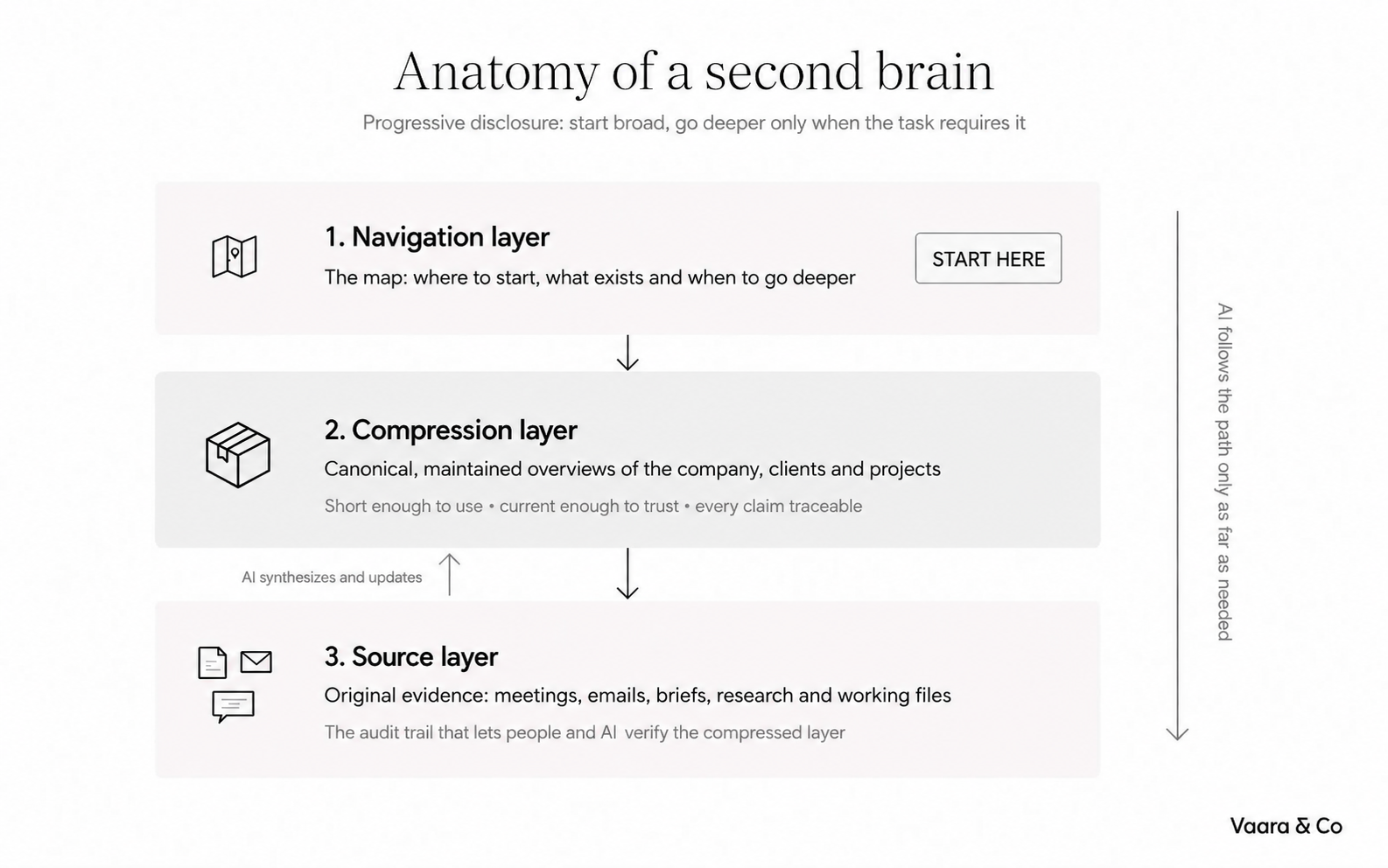
This can sound complex, but AI agents can help build and maintain the system. We need to understand how it works at a high level and oversee how the agents build and update it.
Here’s what this structure might look like for a marketing agency:
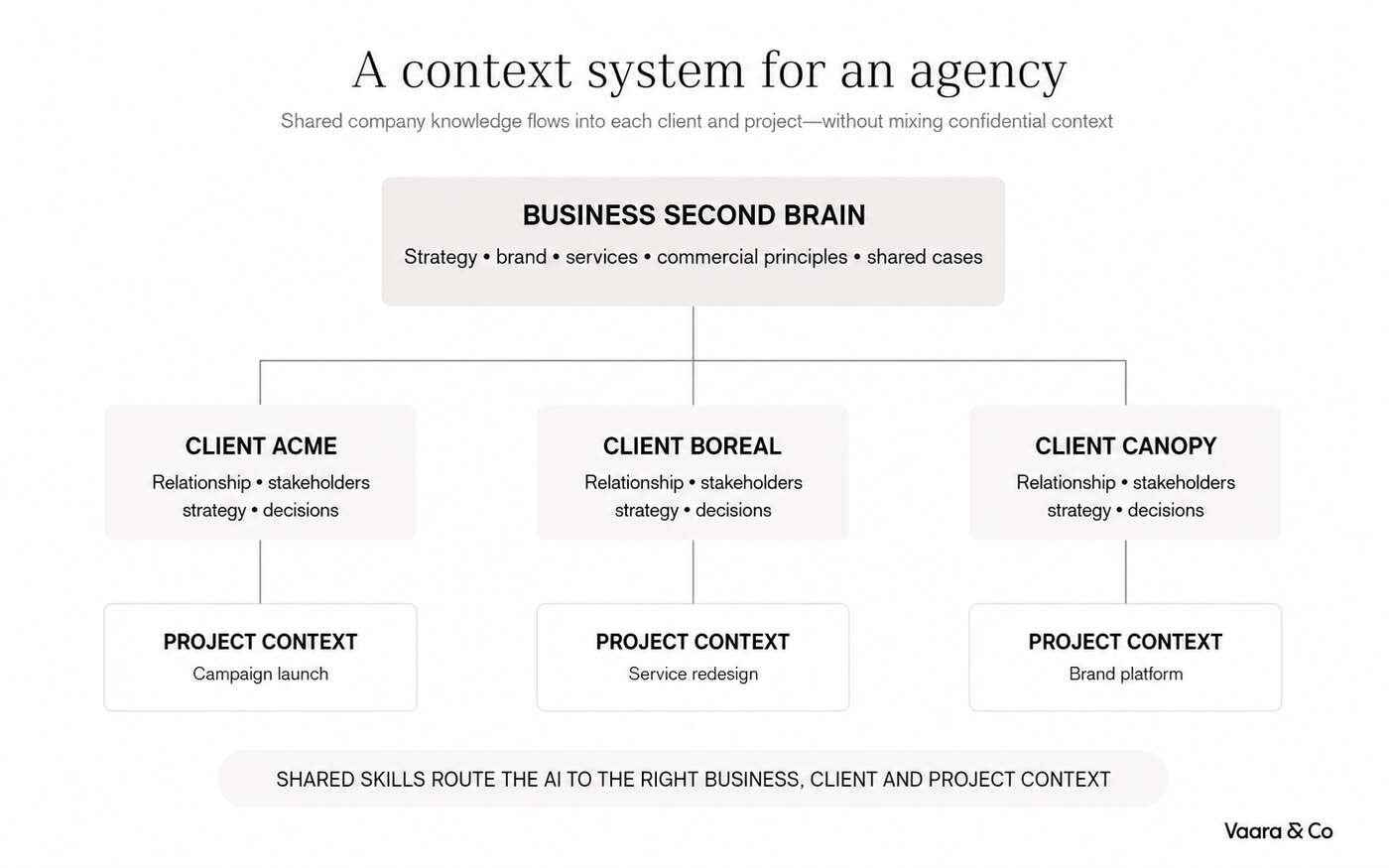
Your team may need several second brains, each with a different scope:
- A business second brain contains relevant context about your company, including its brand, strategy, products and sales pipeline.
- A client second brain accumulates knowledge about a particular client, including past collaboration, stakeholders and strategy.
- A project second brain contains the knowledge relevant to a particular project.
When this system works well, an employee can ground AI work in the relevant knowledge base. We can also build instructions for finding and using that knowledge into Skills.
Knowledge tells the AI what is true; a Skill tells it how your company works.
For example, I can use a Proposal Building Skill to draft a proposal according to our style and best practices. The Skill tells the AI to read the client overview, check our sales pipeline and retrieve only approved case studies relevant to the brief.
3. Keeping the second brain up to date
The value of a second brain depends on how well we maintain it. The governance model should make four things clear:
- Where the data lives (for example, hierarchical Markdown files in Google Drive or OneDrive).
- Who can use the data (everyone, or only people with the relevant access).
- Who can update the data (everyone can submit suggested changes to a queue; named domain owners approve them).
- How AI suggests additions (for example, a scheduled sweep of relevant documents, meeting transcripts and emails).
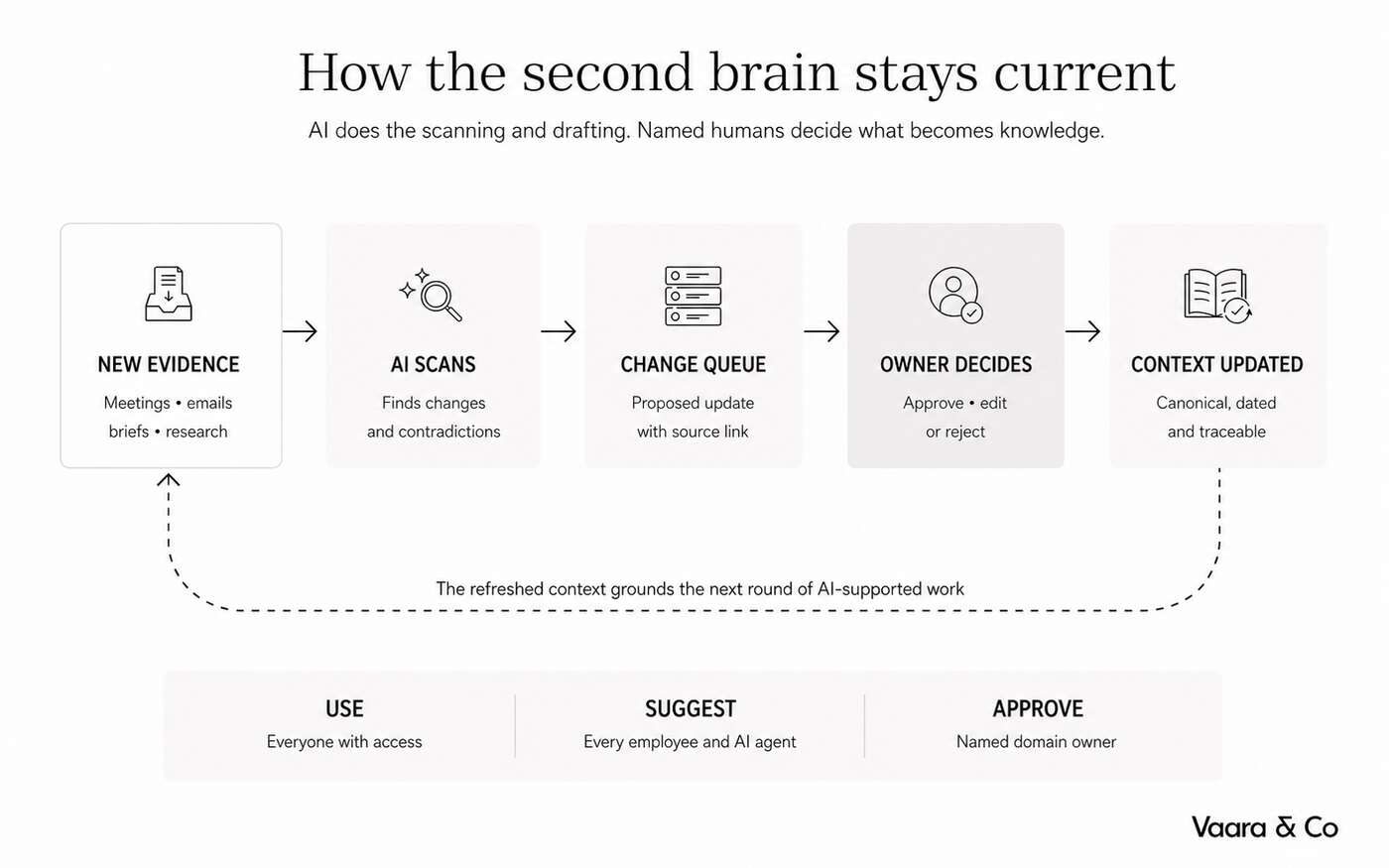
Let’s return to Acme. During a meeting, its Marketing Director reveals that expansion into Germany is the company’s key strategic priority for the first half of 2027.
An automated job scans Acme’s meeting transcripts every morning, adds proposed updates to the “Second Brain Acme” Google Sheet and notifies the client lead. The lead reviews the original source and approves the addition to Acme’s second brain.
Plant the seed to harvest
In the end, Leonard’s memory system fails him. Both he and the audience miss important context because his notes and pictures lack links to original source material and explanations of why they matter. He has no navigation or compression layer connected to the evidence.
His system fails, but the plot works.
Building a shared second brain can feel daunting. Yet curating and sharing context is part of what makes your AI output different from your competitors’. The IP in your context databases and proprietary Skill workflows becomes part of your competitive moat.
Together, a shared workflow library and a second brain help your team turn isolated AI experiments into a consistent source of business value.
We need to invest in these context gardens to reap their benefits, putting in the upfront work and pruning them regularly to keep the knowledge current.
Start small. Build your personal second brain first, then expand to a single project, followed by one client or product team. Keep building your organization’s ability to create context that scales.
To agree on how your team shares context and uses AI in daily work, explore the AI Playbook workshops.